In the sixties AKG, from Vienna, Austria was a very innovative company, always eager to market new products for the evolving market of (semi-)pro musicians. Their portable spring reverb unit BX 10 had been an enormous succes with studio engineers, and in 1963 the company decided to make the same technology available to vocalists on stage.
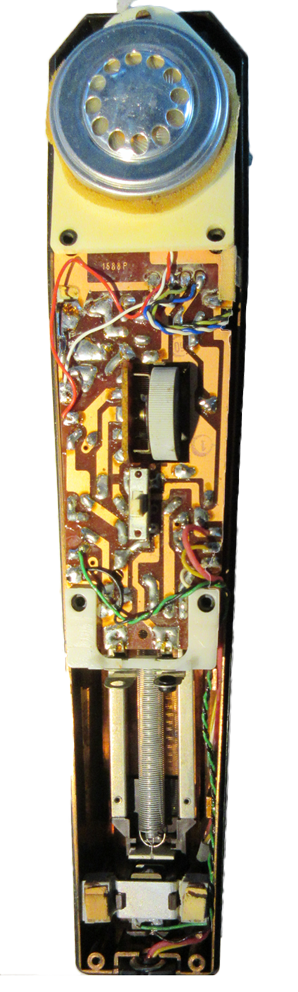
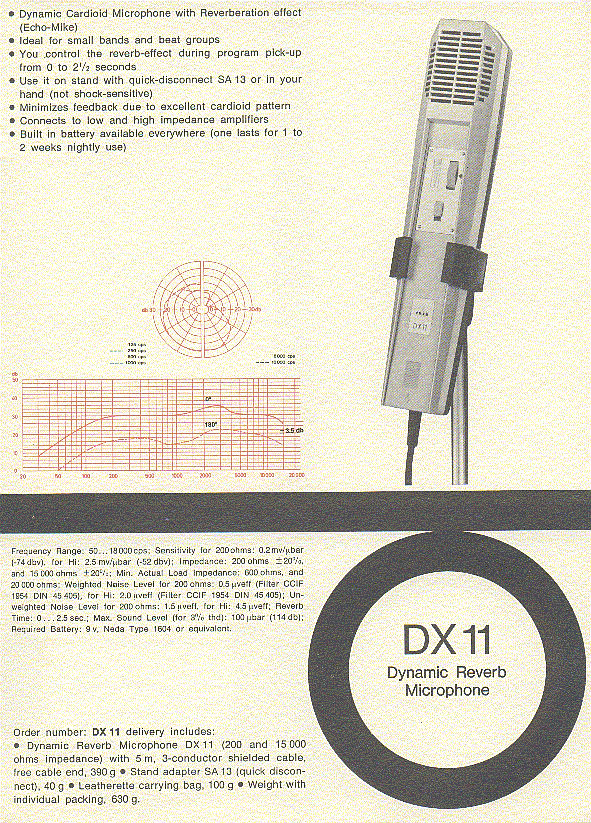
At the time singers only had modest amplifiers with small speaker columns at their disposal, Public Address systems with sound-technicians and effect equipment were still a thing from a distant future. AKG decided to give vocalists complete control, by putting a miniaturised spring-reverb inside a microphone, combine it with the same quality dynamic cardioid capsule used in their side addressed D 14 vocal microphone and power the necessary electronics with a 9 volt battery. The output impedance could be chosen between 200 Ω and 10.000 Ω; again for pro- and semi-pro use.
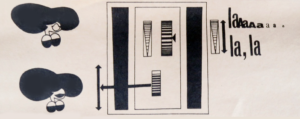
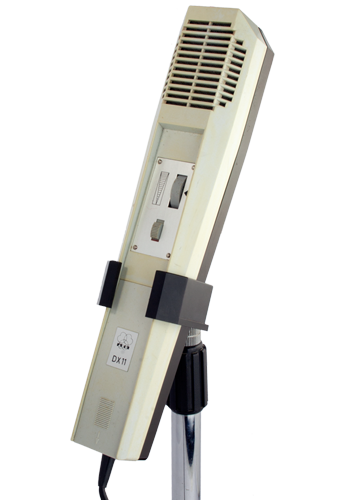
Entertainers could adjust the length of the reverb from 0 to 2.5 seconds (ranging from subtle to huge), by rotating the wheel at the front and turn it on or off with the switch beneath it, without any external help. The system was quite compact and the DX 11 could be used as a hand held microphone although brisk movement triggered the reverb springs into action, so it was more sensible to use it on a stand with the supplied mount. Since this quirky design weighed 500 grams nobody wanted to hold in their hands for a whole performance.
Although the theory was sound, this effect-mic never really became popular with artists.The same problem faces AKG with almost their entire microphone product range of today; not one of their modern models is as popular as the Sennheisers, Neumanns and Shures, but then again vintage AKGs like the DX 11 are very collectible.
It faded out of production around 1972, but was also made as an OEM. Badged for Philips and Grundig (as GHM 328), they are even harder to find.