I really don’t want to imply that in the past everything was better, but it certainly applies to this microphone of the month. Before, I described the KM 140 as the last real Neumann, the KMS 150 is closely related and has the same sublime quality.
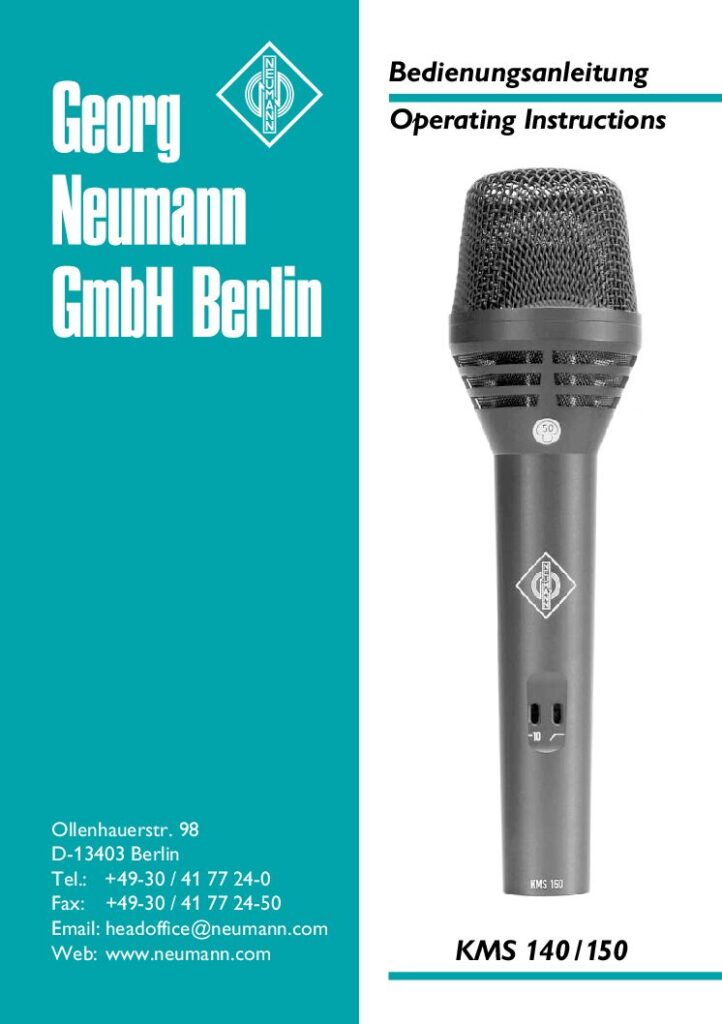
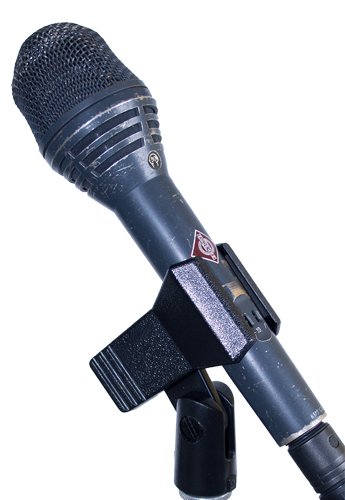
Although it has the same capsule as the small KM 150 (KM 100 preamplifier with KM 50 with hypercardioid recording characteristic), Neumann turned this into a robust hand-held vocal and instrument microphone, intended for both the stage and the studio. The extra sturdy metal housing contains two recessed switches, for 10dB attenuation, for very loud singers or instruments, and a low-cut filter. The preamplifier and the capsule are acoustically isolated and therefore shock-free. The basket has two layers of sturdy mesh, which prevents pop sounds, but is so transparent that it allows all frequencies, from low to high, to pass.
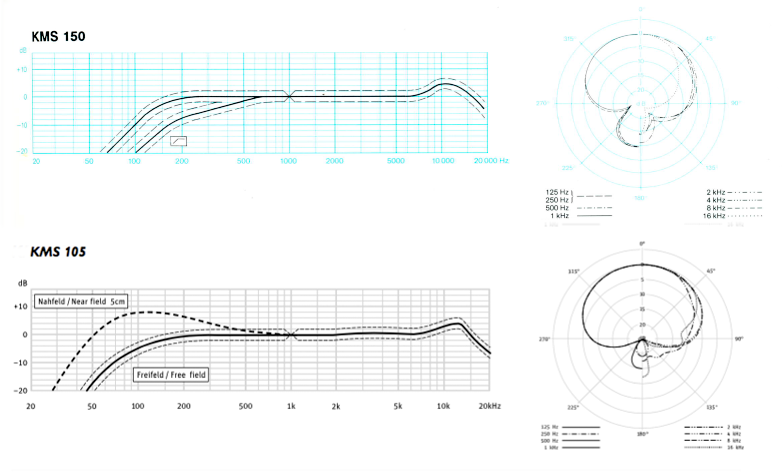
It is the transparency and its musical quality that ultimately makes this model sound much nicer than its successor, the now widely praised (by others) KMS 105.
Since Neumann was bought by Sennheiser, all production has become ‘cost effective’. The sales price of the KMS 150 was around € 1600, the KMS 105 costs approximately € 600: a huge reduction, which was not just the result of smarter production. Nor was it because the beautiful wooden storage box was replaced by a simple nylon zippered bag.
One could almost speak of a placebo effect: anyone who buys a Neumann nowadays thinks they are going to get to use the very best, but cost savings come first, thus the customer actually spends half of the purchase price on the name ‘Neumann’ and the remains for a product that will never truly become legendary for its quality.

Neumann made vocal microphones for the stage from 1972 onwards. The first model was the KMS 85, ‘the traffic light’, the second the KMS 84, from 1977, a KM 84 microphone in a sturdier housing, with switches for a low-cut filter, for close-range use and -10dB attenuation. The KMS 140 cardioid and 150 hyper cardioid, from 1988, and from about 1996 on, the current KMS 104 and 105. The latter do not have a switchable low-cut filter, they are intended for use very close, optimally at 5 cm, which makes these types less versatile and they are therefore not intended by Neumann as an instrument microphone. Because the -10 dB switch is also missing, the modern versions can be less precisely matched to the user. The dimensions, 175 mm length x 48 mm diameter, the weight of 285 grams and the technical specifications have remained practically unchanged.
The sound of the modern versions is less musical, they sound sharper, just like the KM184 compared to its predecessors. Some singers run into sibilance issues because of that sound.
This is not to say that the KMS 104 and 105 are bad microphones, on the contrary, but there are good alternatives and it is absolutely recommended for those who are considering spending around € 600 on a vocal microphone, to consider those alternatives by, for example, Shure and DPA, and check those out thoroughly.
Anyone who wants to opt for a vintage KMS140/150 will have to dig deeper into their pockets to afford it, when one can be found, fortunately they are almost indestructible.
Neil Young is known as someone who wants the very best, so he still uses KMS 150s for his vocal parts and those of his backing band.