
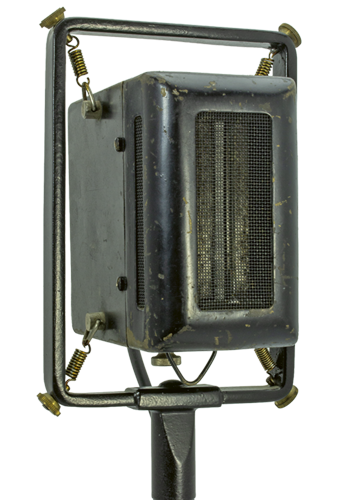
Siemens & Halske was the German company that produced the first ribbon microphones. They were invented in 1924 by Erwin Gerlach and Walter Schottky.
At the time, two versions were produced: the Rel. mph. 1A Large ribbon microphone with electromagnets, mounted on a large preamplifier, and the smaller Rel. mph. 2A ribbon microphone with permanent magnets.
The ribbon system worked in both directions: it could record and reproduce sound. Gerlach and Schottky also presented a ribbon loudspeaker. In combination with a long horn, this produced a clear, audible sound up to a distance of 800 meters.
The Large ribbon microphone had a bidirectional pickup pattern; the Small one probably did too, although I am not certain of that; I have only seen an image of one side of that microphone. The Large one was used by German radio, but its size was unwieldy and it was prone to interference.
The ‘Small Rel. mph. The 2A was upgraded to the ELM 21 around 1925-1927. This featured a closed back and a transformer built into the four horseshoe magnets of the ribbon element to level the signal. Because the back of the ribbon element was damped, this effectively made the ELM 21 the very first microphone with a directional pickup characteristic.
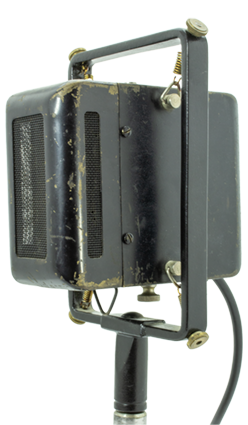
It was produced in small numbers; some of these were used in German parliament from 1930 until 1933.
The construction of the microphone was very basic; acoustically it was far from perfect, nevertheless, it worked pretty good and was even used outdoors. Later ribbon microphones were fitted with baffles if they needed to be used outside, like on film sets.
Gerlach & Schottky provided the aluminium ribbon between the magnets with a large number of fine transverse ribs to increase the transverse stiffness of the ribbon and to allow the ribbon to make large swings without significant retarding forces occurring. It also made for a soft suspension that made the ribbons own vibration inaudible. This system was later copied by Harry Olson for his RCA ribbon mics (these days known as ‘zig-zag ribbons’).

Siemens & Halske Großes Bandmikrofon Rel.mph.1a

Siemens & Halske Kleines Bandmikrofon Rel.mph.2a First version

Siemens & Halske ELM 21 ribbon motor with 4 horse-shoe magnets
The ELM 21 was in turn replaced by an updated design: the ELM 25, the first true ribbon microphone production model, from 1929, which became widely used in Germany, and made its way to the US to inspire Harry Olson and later ribbon microphone makers.


S&H ELM 21s in de Reichstag, German parliament, Berlin, in 1932